Isha Netralaya | Best Eye Hospital in Mumbai & Pune | Eye Specialist







Isha Netralaya | Best Eye Hospital in Mumbai & Pune | Eye Specialist
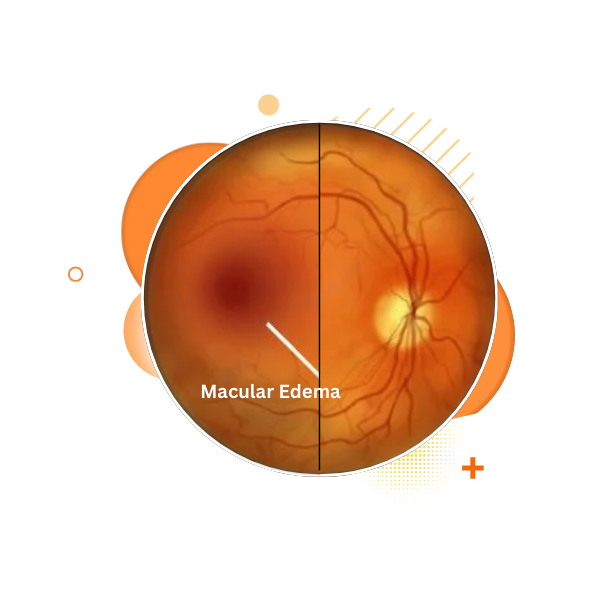
Macular edema is an eye condition in which fluid accumulates in the macula, the central part of the retina responsible for sharp and detailed vision.
When fluid leaks into the macula, it causes swelling and thickening, leading to blurred or distorted central vision. If left untreated, macular edema can result in permanent vision damage.
The macula helps us:
Read clearly
Recognise faces
See fine details
Perform tasks requiring sharp vision
Even mild swelling in the macula can significantly affect daily activities like reading and driving.
Macular edema can develop due to several eye and systemic conditions, including:
Diabetes (Diabetic Macular Edema – most common cause)
Retinal vein occlusion (blocked retinal veins)
Eye surgery (especially cataract surgery)
Inflammation inside the eye (uveitis)
Retinal diseases
High blood pressure affecting retinal vessels
Eye injury or trauma
The condition may affect one or both eyes, depending on the cause.
Symptoms usually develop gradually and may worsen over time:
Blurred or fuzzy central vision
Difficulty reading small print
Distorted or wavy vision
Colours appearing dull or faded
Dark or empty spot in central vision
⚠️ Peripheral (side) vision usually remains normal.
Occurs due to long-standing diabetes
Caused by leakage from damaged retinal blood vessels
One of the leading causes of vision loss in diabetics
Characterised by cyst-like fluid pockets in the macula
Common after eye surgery or inflammation
Caused by blocked retinal veins
Leads to sudden or progressive vision loss
You may be at higher risk if you:
Have diabetes
Have high blood pressure or cholesterol
Had recent eye surgery
Have retinal vascular diseases
Have eye inflammation
Are above 50 years of age
Regular eye check-ups are crucial for early detection.
Macular edema is diagnosed using:
Dilated retinal examination
Optical Coherence Tomography (OCT) – a painless scan that measures retinal swelling
Retinal imaging or angiography (if required)
OCT is the most important test for detecting and monitoring macular edema.
Macular edema does not usually resolve on its own.
Management focuses on:
Treating the underlying cause
Reducing retinal swelling
Preserving central vision
Early diagnosis allows better visual outcomes and prevents long-term damage.
Vision improvement depends on the cause and duration of swelling
Early-treated cases have better outcomes
Regular follow-up is essential
Chronic untreated edema may cause permanent vision changes
Consult an eye specialist immediately if you notice:
Gradual or sudden blurring of central vision
Distortion of straight lines
Difficulty reading or recognising faces
Vision changes despite stable glasses
Early evaluation can prevent permanent vision loss.
Macular edema is the swelling or thickening of the macula, the central part of the retina, caused by fluid leakage from damaged blood vessels. It can lead to blurred or distorted vision and is often associated with diabetic retinopathy, retinal vein occlusion, or uveitis.
Symptoms include blurred or distorted central vision, difficulty with color perception, and a decrease in visual acuity. In more advanced cases, there may be significant vision loss.
Macular edema is diagnosed through a comprehensive eye exam, including optical coherence tomography (OCT) to assess fluid accumulation in the macula and evaluate the severity of the condition.
Recovery time depends on the type of treatment. Injections or laser treatment typically involve minimal downtime, and you may experience some improvement in vision within weeks to months. For more invasive procedures like vitrectomy, recovery can take several weeks to months.
Yes, macular edema can lead to permanent vision loss if not treated appropriately. Early detection and timely treatment are crucial for preserving central vision.